

 Written by
Finding your first apartment in Canada can feel like a catch-22. Landlords want to see Canadian credit history and references. You can’t build Canadian credit history without living here for a while. And in the meantime, you need somewhere to live. Renting in Canada with no credit history is possible, and this guide shows you how.
It’s one of the most stressful parts of arriving, and it’s one of the most common questions newcomers ask. Here’s how to approach it, and how to protect yourself while you do.
Understand what landlords are worried about
When a landlord asks for a credit check, they’re really asking one question: “Will this person pay the rent on time, every month?”
Your job is to answer that question in other ways. The more evidence you can show, the stronger your application.
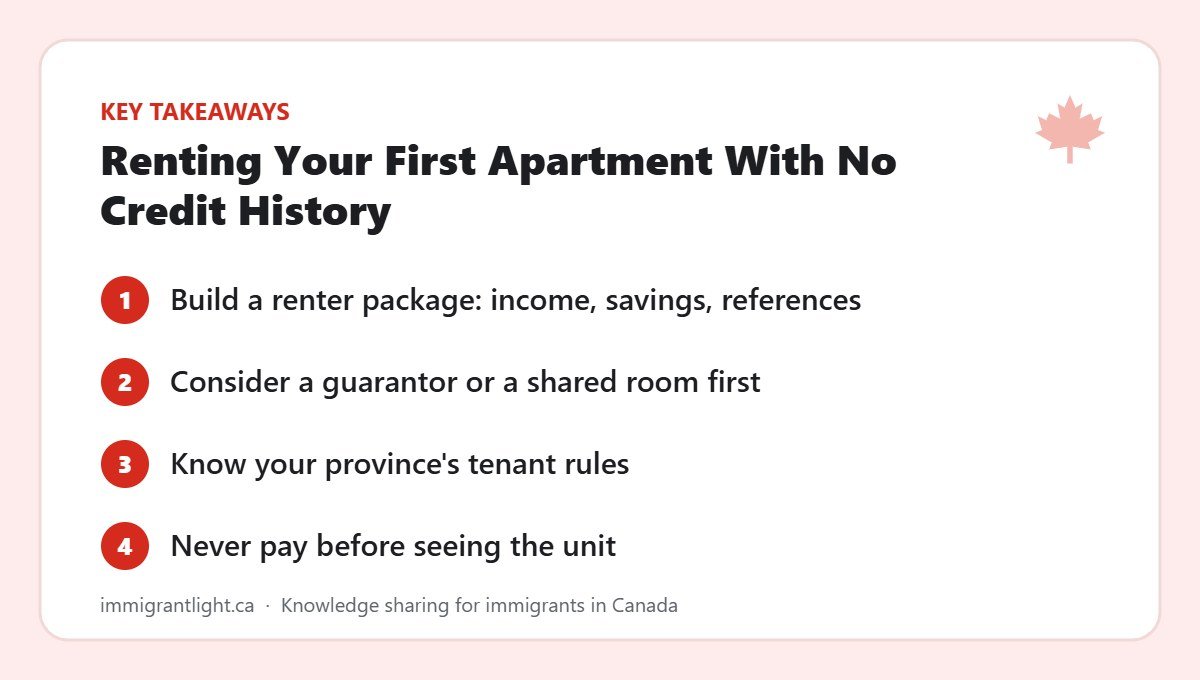
Build a “renter package”
Prepare a folder (paper and PDF) you can send quickly. Good apartments go fast. Include:
- Photo ID and proof of your immigration status.
- Proof of income: a job offer letter or employment letter, recent pay stubs, or proof of income from abroad if you’re still job hunting.
- Proof of savings: recent bank statements showing you can cover rent for several months.
- References: a previous landlord (even from your home country), an employer, or a settlement worker who knows you.
- A short introduction letter: who you are, why you moved, your job or plans, and why you’ll be a responsible tenant.
- Your credit report, if you’ve started building Canadian credit. (See my guide to Building Credit in Canada From Zero.)
A friendly, well-organized package makes you stand out from applicants who just send a one-line message.
Other ways to strengthen your application
- A guarantor: someone with good Canadian credit who agrees to pay if you can’t. This is common, but only ask someone who understands the commitment.
- Paying more rent upfront: some landlords may accept extra months of rent in advance. Be careful here: rules on deposits and prepaid rent vary by province, and handing over large sums is risky if the rental turns out to be a scam. In Ontario, for example, landlords can generally only collect a deposit toward the last month’s rent, and separate damage deposits aren’t allowed.
- Newcomer-friendly landlords and property managers: some are used to working with newcomers. Settlement agencies often know which ones.
- A shared room first: renting a room in a shared house often requires fewer documents and lets you build a Canadian rental history.
Know your rights
Tenant laws are set by each province. Before you sign anything, look up your province’s rules. A few things to know:
- Ontario requires most residential leases to use the government’s Standard Form of Lease.
- Landlords in every province are generally prohibited from discriminating against you because of your race, place of origin, religion, family status or other protected grounds under human rights law.
- There are rules about deposits, rent increases and when a landlord can enter your home.
Your province’s tenant board or housing office website explains your rights in plain language, and settlement agencies can help if you run into problems.
Avoid rental scams (please read this part)
Newcomers are a favourite target of rental scammers. Red flags:
- The price is much lower than similar places nearby.
- The “landlord” is out of the country and can’t show you the unit.
- They ask for a deposit before you’ve seen the place or signed a lease.
- They want payment by wire transfer, cryptocurrency or gift cards.
- They pressure you to decide immediately.
Always see the unit in person (or have someone you trust see it), confirm the person actually has the right to rent it, sign a written lease, and get a receipt for every payment.
Where to search
- Major rental listing websites and apps
- Local community and cultural groups
- Your settlement agency
- University or college housing boards if you’re a student
- Word of mouth. Tell everyone you meet that you’re looking.
Budget realistically
Rent in big cities can take a large share of your income. Before you sign, add up rent, utilities (if not included), tenant insurance, internet and transportation. Tenant insurance is often inexpensive and protects your belongings and your liability. Some landlords require it.
Frequently asked questions
Can I rent an apartment in Canada with no credit history?
Yes. Many newcomers rent without Canadian credit history by providing proof of income or savings, references, a guarantor, or by starting with a shared room.
What documents do I need to rent an apartment in Canada as a newcomer?
Photo ID, proof of immigration status, proof of income or a job offer, bank statements showing savings, references and, if available, a Canadian credit report.
How can I avoid rental scams in Canada?
Never pay a deposit before seeing the unit and signing a lease, avoid wire transfers, gift cards and cryptocurrency, and be suspicious of prices far below market or landlords who can’t meet in person.
Free download: Get the ImmigrantLight 90-Day Newcomer Checklist, a printable, week-by-week guide to your first three months in Canada.
Most settlement agencies offer free help with finding housing. Find one in your city on our Resources page.
— Williams
Searching for a place right now? Ask for tips (and warnings) in our anonymous Settlement & Education community.