

 Écrit par
If you studied outside Canada, sooner or later someone will ask you: “Has your degree been assessed?” Employers, colleges, licensing bodies and immigration programs often want to know what your foreign education is worth in Canadian terms. That is exactly what an educational credential assessment (ECA) answers.
That’s what an Educational Credential Assessment (ECA) does. It sounds bureaucratic, and honestly it is a bit, but it’s one of the most useful pieces of paper a newcomer can have. Here’s how it works, in plain language.
What is an ECA?
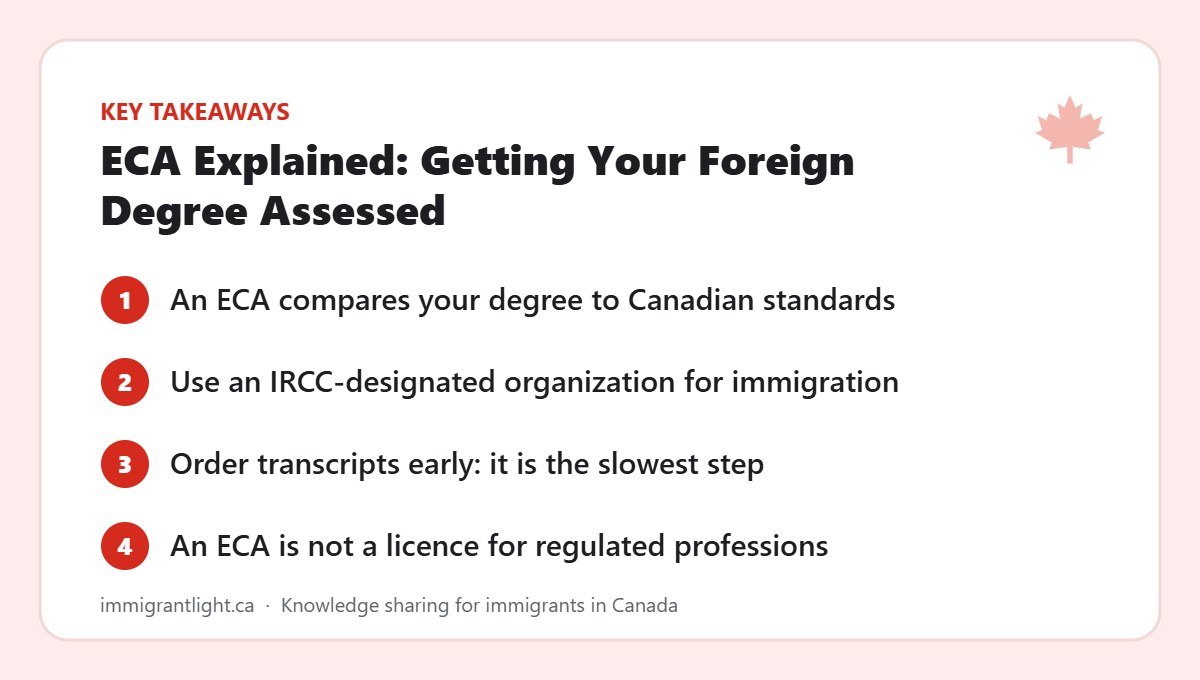
An ECA is a report that compares your foreign degree, diploma or certificate to its Canadian equivalent. For example, it might say that your four-year degree is equivalent to a Canadian bachelor’s degree.
It does not give you a licence to practise a profession, and it doesn’t guarantee a job. What it does is give Canadian employers, schools and government programs a trusted way to understand your education.
When do you need one?
- Immigration: Many economic immigration programs, such as Express Entry, require an ECA if you want points for education completed outside Canada.
- Jobs: Some employers ask for it. Even when they don’t, adding “assessed as equivalent to a Canadian bachelor’s degree” to your resume removes guesswork for recruiters. (More on that in my Canadian resume guide.)
- Further study: Colleges and universities may ask for an assessment when you apply.
- Licensing: Regulated professions usually have their own assessment process through the provincial regulator, sometimes in addition to, sometimes instead of, a general ECA.
Resume Makeovers: Before and After
Three examples of turning duties into achievements, plus space to rewrite yours.
Get it free
Who can do an ECA?
For immigration purposes, IRCC only accepts ECAs from organizations it has designated. These include:
- World Education Services (WES)
- International Credential Assessment Service of Canada (ICAS)
- International Qualifications Assessment Service (IQAS)
- Comparative Education Service (CES) – University of Toronto
- International Credential Evaluation Service (ICES)
- Conseil médical du Canada – for physicians
- Pharmacy Examining Board of Canada – for pharmacists
Always check the current list on the official IRCC website before you apply, because designations can change.
How to choose
For most people, the choice comes down to three things:
- Your profession. Doctors and pharmacists must use their professional body (the Medical Council of Canada or the Pharmacy Examining Board of Canada) for immigration purposes.
- Your country and school. Some organizations have established processes for certain countries or can receive documents more easily. Ask people from your country in our Settlement & Education community which one worked for them.
- Cost and processing time. These vary between organizations and change over time. Compare current fees and timelines on each organization’s website.
The step-by-step process
- Pick your organization and create an account on its website.
- Choose the right type of report. If it’s for immigration, make sure you select the ECA for IRCC purposes, not just a general evaluation.
- Pay the fee.
- Request official documents from your school. Most organizations require your transcripts to be sent directly from your university or college in a sealed envelope or through a secure electronic system. This is often the slowest part.
- Send any documents you have to provide yourself, such as a copy of your degree certificate.
- Wait for the report, then keep it safe. You’ll use it again and again.
Tips to avoid delays
- Start early. Getting your home institution to send documents can take weeks or months, especially if you can’t visit in person.
- Use the exact name on your passport. Name mismatches are a common source of delays.
- Get certified translations if your documents aren’t in English or French and the organization requires them.
- Check the validity period. For immigration, ECAs are typically valid for a limited time (five years is common), so check the dates if you’re applying for permanent residence.
- Keep copies of everything you send, and tracking numbers for courier packages.
What about regulated professions?
If you’re a nurse, engineer, doctor, accountant, teacher or work in another regulated profession, your provincial regulator decides whether you can practise. An ECA helps with immigration and employers, but you’ll also need to follow your regulator’s licensing path. For nurses, I’ve written a full guide: How Internationally Educated Nurses Get Registered in Canada.
Put your ECA to work
Once you have it:
- Add the Canadian equivalency to your resume and LinkedIn.
- Use it when applying to bridging programs, colleges and jobs.
- Mention it in interviews if your education comes up.
An ECA won’t open every door on its own, but it removes one of the biggest question marks employers have about newcomers.
Questions fréquentes
What is an Educational Credential Assessment (ECA)?
An ECA is a report from a designated organization that compares your foreign degree, diploma or certificate to its Canadian equivalent.
Which organizations can do an ECA for Canadian immigration?
IRCC-designated organizations include WES, ICAS, IQAS, the University of Toronto’s Comparative Education Service, ICES, the Medical Council of Canada for physicians and the Pharmacy Examining Board of Canada for pharmacists. Check IRCC’s website for the current list.
Does an ECA let me work in a regulated profession?
No. An ECA compares your education to Canadian standards, but to practise a regulated profession you must be licensed by the provincial regulator for that profession.
Free download: Get the ImmigrantLight 90-Day Newcomer Checklist, a printable, week-by-week guide to your first three months in Canada.
Not sure how credential recognition works in your province? Many settlement agencies offer free guidance. Find one in your city in our newcomer services directory.
— Williams
Not sure which organization to choose for your country? Ask people who’ve done it in our anonymous Settlement & Education community.
Keep going: related guides and discussions
- IELTS vs CELPIP vs TEF: which language test to take
- Engineers: getting your P.Eng as an internationally trained engineer
- Accountants: approaching the CPA designation
- Nurses: how long did NNAS and your provincial college take?
- International medical graduates: your licensing roadmap
- No Canadian experience? 7 ways newcomers land jobs